The administration proposed a return to allowing congregate sheltering for families — a practice that has been prohibited for years due to concerns about health and safety risks.
By Meagan Flynn
D.C. Mayor Muriel E. Bowser’s administration is preparing for the city’s family shelters to fill up under a budget proposal that cuts certain housing programs, pivots the city’s homelessness strategy and seeks a return to congregate shelter — a prospect that has alarmed homeless advocates and organizations.
The city is planning to keep families in shelters for longer periods rather than automatically providing them a housing subsidy known as rapid rehousing — a program that is facing steep cuts in the budget and that many have argued is flawed and in need of reform.
With more families staying in shelters for longer, the administration is anticipating that it will run out of rooms in its family shelters, leading the Department of Human Services to begin searching for backup options.
As part of that plan, the administration proposed in the budget a return to allowing congregate sheltering for families — a practice that has been prohibited for years due to concerns about health and safety risks for families with children. Rachel Pierre, interim director of the human services department, says housing people in shared spaces is intended only as a last resort if the city runs out of private rooms.
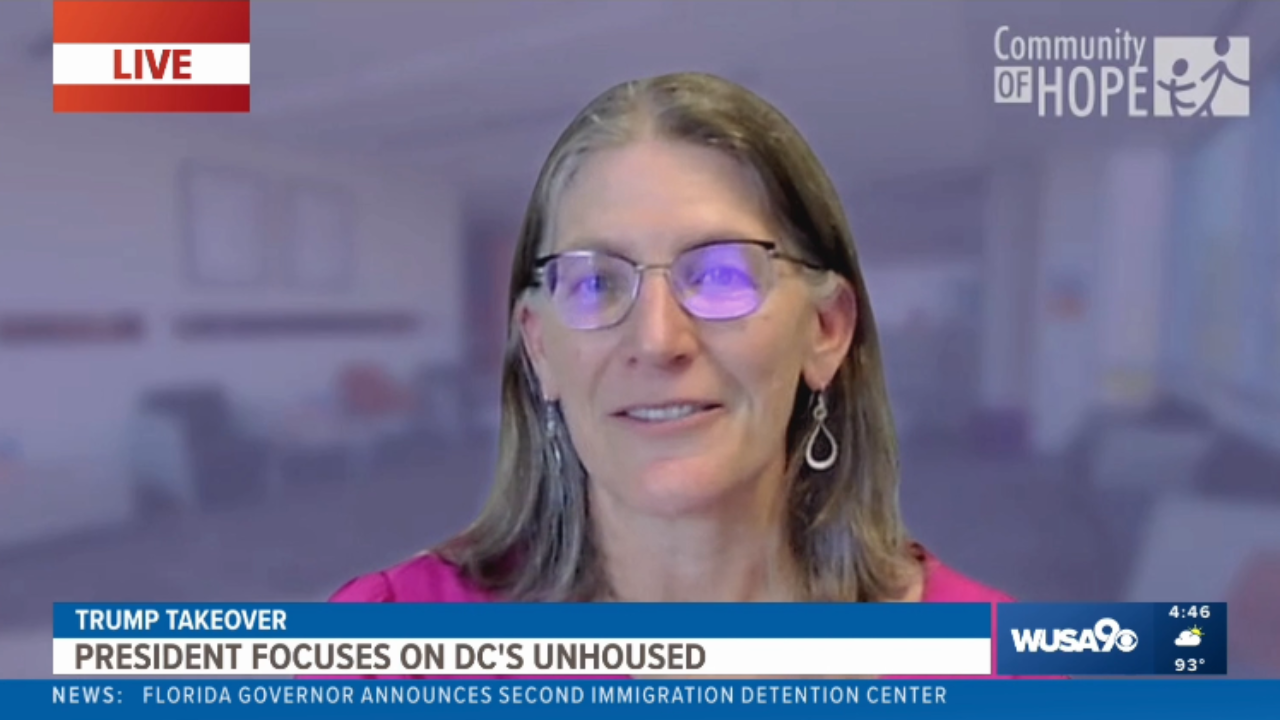
But the fact that the administration is anticipating such sheltering will be possible has unsettled various homeless services providers. Kelly Sweeney McShane, president and chief executive of Community of Hope, said in an interview that despite so much progress on family homelessness over the past decade, she feared any return to the congregate approach could be a “slippery slope” that could bring D.C. back to its darker days of people languishing in crowded shelters.
McShane recently joined a rally outside the Wilson Building to lobby council members to reverse courseon various cuts.
“I remember what it was like 35 years ago,” she said. “Families only had access to shelter in hypothermia weather. There were congregate shelters, families stayed sometimes for years, and the shelters were always full. … I’m very concerned that this budget includes drastic changes that will bring us back to the former days.”
The changes to how the city will address family homelessness are one piece of Bowser’s $21.8 billion budget proposal that includes cuts to the District’s social safety net programs.D.C. Council Chairman Phil Mendelson (D) is expected to release a revised budget proposal that could reverse various elements of Bowser’s, with the full council taking it up on an initial vote Monday.
Under Bowser’s proposal, emergency rental aid is seeing steep cuts, and there are no new vouchers funded for individual homeless adults. Roughly 27,000 adults who rely on the District’s Healthcare Alliance Program — including undocumented immigrants ineligible for Medicaid — are slated to lose their health care, and another 25,000Washingtonians are expected to be booted from Medicaid onto other health care plans that probably won’t include vision and dental care and behavioral health services.
The Bowser administration has proposed cuts to the Temporary Assistance for Needy Families program as well as stricter eligibility and work requirements — changes that council member Matthew Frumin (D-Ward 3) sought to reversefor fiscal year 2026 but that could go into effect in 2027.
“It’s clear that the harmful policies that are being pushed right now and the cuts in the budget are just going to lead to increased homelessness overall, particularly family homelessness,” said Brit Ruffin, legal director of systemic advocacy and litigation at the Washington Legal Clinic for the Homeless.
The proposed cuts came after the city’s chief financial officer projected a $1 billion shortfall over the next several years due largely to federal job cuts and a sluggish downtown real estate market. Bowser’s budget proposal took a pro-business approach to try to blunt the projected economic downturn, while reining in high-cost programs that her administration says have become fiscally unsustainable — including rapid rehousing.
For about a decade, rapid rehousing has been at the center of the Bowser administration’s strategy to reduce family homelessness. The program was intended as a 12-month rental subsidy, buying families time to get back on their feet. But often, at the end of the 12 months, many families were not able to afford market-rate rent and risked becoming homeless once again. During the pandemic, the administration offered long-term extensions to families in the program, some of whom remained for years as costs ballooned.
Pierre said the human services department decided it was both unsustainable financially and for families. She acknowledged that the program was not setting up families for success, and that families entering the shelter system need a more personalized plan.
Moving forward, “we really wanted to diversify the options that we offer families who are coming to shelter and exiting shelter,” Pierre said. “The idea of having one-size-fits-all moving everybody from shelter to [rapid rehousing] was just not sustainable for families. We’ve heard a lot from families saying that this was just not working for them.”
Under the new plan, Pierre said only families for whom rapid rehousing makes sense — such as if they experienced a temporary life crisis — will be offered the program. Bowser proposed a $17 million cut to rapid rehousing given the approach. Other programs that got boosts, such as D.C. Flex — which offers $8,400 in cash assistance per year — or the Homelessness Prevention Program, may be available for other families. That could include cash assistance to move to an apartment outside the District.
Pierre said that taking more time to identify how best to help families will cause their lengths of stay to increase in shelters, leading to the anticipated capacity problems.
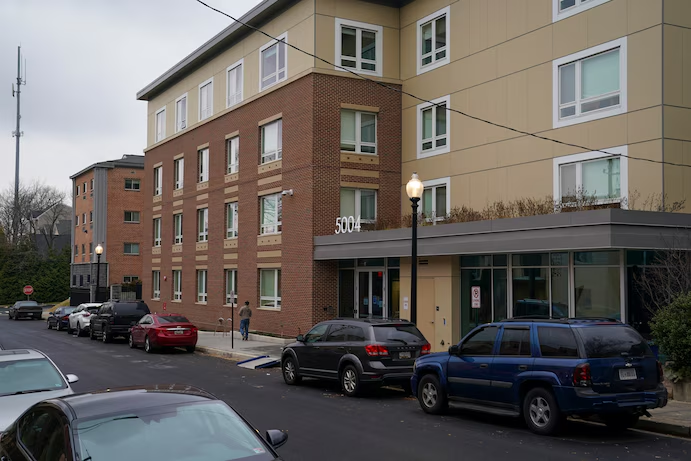
The District’s newer network of family shelters was a hallmark of Bowser’s tenure, as she promised to close D.C. General — the former mega-shelter in Southeast with deplorable conditions — and replace it with smaller shelters across the city. They are far from at capacity, but Pierre said that could change if the new proposals become law.
The human services department is exploring returning a couple of apartment-style shelters serving single adults back to the family shelter system, and it is looking at Harbor Light on New York Avenue NE for congregate space if needed. Pierre called the congregate space a “precautionary measure” that gives the administration flexibility.
Ruffin, from the Legal Clinic for the Homeless, said she supported a more tailored approach to rapid rehousing to ensure families could actually benefit from the program. But that shouldn’t mean rolling back long-fought rights for low-income families, she said.
She strongly opposed returning to congregate sheltering, pointing to the city’s sordid history with it. In 2014, a court ruled the city violated the prohibition on congregate shelters when it put homeless families in recreation center gymnasiums, with little privacy and unsanitary shared bathrooms. The council that year, including then-council member Bowser, unanimously voted to affirm the right for homeless families to have a private room as the D.C. government continued to fight the court case.
Frumin, chairman of the council’s human services committee, said he initially sought to strike the administration’s proposal to allow congregate shelters but did not move forward after the administration warned it would cost $20 million. According to the human services department, that projection was based on what it would cost to put up to 155 families in a non-congregant shelter or rapid rehousing, vs. a cheaper congregate shelter option.
Frumin said that after visiting Harbor Light — a large facility formerly operated by the Salvation Army that had served migrant families — he was willing to hear out the administration on the idea, while exploring with council colleagues whether they can add any conditions to ensure safety.
“Maybe there’s a more tailored way to let them do it,” Frumin said. “And that’s what we’re exploring, whether or not that’s something that can be done at a lower cost and in a way where people would feel comfortable.”
Ruffin and others argued that, without significant investment in more tools to exit families into sustainable long-term housing, too many families may languish in shelters. Ruffin applauded the 156 permanent supportive housing vouchers the mayor proposed for families exiting rapid rehousing, compared with her proposed zero last year — but she said that is far from enough to address the need.
Lara Pukatch, chief advocacy officer at Miriam’s Kitchen, called the budget’s lack of housing resources, and no new vouchers for single adults, “unconscionable. “Outside the Wilson Building last week, she said street outreach workers have already been told to stop trying to connect homeless people with vouchers because there will not be any available for them come October.
“This means that we will not be able to connect a single new individual living outside or in shelter to housing for over a year, if at all,” Pukatch said.
Pierre said the agency is still working through a backlog of vouchers for single adults who have yet to use them to move into a unit.
McShane of Community of Hope said all of the challenges combined complete a full picture, one where the lowest-income Washingtonians are pushed further to the margins. She and other organizations are arguing to the council that at a time when Congress is slashing social safety net programs, D.C. should be doing more to fill the gap.
“In this federal context, where there’s going to be a lot more people uninsured, where you’re looking at reductions to food, you’re going to have a lot of people living on the edge,” she said. Many of them, she said, will probably show up on the doorstep of city shelters.
Correction: A previous version of this article on second references incorrectly referred to the D.C. Department of Human Services as the health services department. It also had the incorrect title for Brit Ruffin.